The Third Sunday in Epiphany: Jesus' Call to Us

by Fr. Bill Garrison


Please note that the following sermon text was provided prior to the audio recording. The two versions may differ substantially.


Now when Jesus heard that John had been arrested, he withdrew to Galilee. He left Nazareth and made his home in Capernaum by the sea, in the territory of Zebulun and Naphtali,  so that what had been spoken through the prophet Isaiah might be fulfilled:

“Land of Zebulun, land of Naphtali,
    on the road by the sea, across the Jordan, Galilee of the Gentiles—
the people who sat in darkness
    have seen a great light,
and for those who sat in the region and shadow of death
    light has dawned.”

From that time Jesus began to proclaim, “Repent, for the kingdom of heaven has come near.”

As he walked by the Sea of Galilee, he saw two brothers, Simon, who is called Peter, and Andrew his brother, casting a net into the sea—for they were fishermen. And he said to them, “Follow me, and I will make you fish for people.” Immediately they left their nets and followed him. As he went from there, he saw two other brothers, James son of Zebedee and his brother John, in the boat with their father Zebedee, mending their nets, and he called them. Immediately they left the boat and their father, and followed him.

Jesus went throughout Galilee, teaching in their synagogues and proclaiming the good news of the kingdom and curing every disease and every sickness among the people.

—Matthew 4:12-23 (NRSV)


As a reminder we are still in the season of Epiphany. It is the time of the year when we expect the unexpected, and that which was not visible becomes so. We look at things from a different angle and see things from another perspective. This week we are going to look at being ready when the moment comes. Here is one example.

The strongman at a circus squeezed the juice from a lemon between his hands. He then said to the audience, “I will offer $200 to anyone in the audience who can squeeze another drop from this lemon. A thin scholarly looking woman came forward, picked up the lemon, strained hard and managed to get a drop. The strongman was amazed. He paid the woman and asked, “What is the secret of your strength?" “Practice," the woman answered. “I was the treasurer of an Episcopal Church for thirty-two years!"

Photo by Almog

Photo by Almog

The gospel this morning is one with which we are familiar. It’s the story of Jesus beginning to call his disciples. He has returned to Galilee after his time in the desert and his baptism and is walking beside the Sea of Galilee close to his new home in Capernaum. The Sea of Galilee, by the way, hasn’t changed much in the last two thousand years. It’s the lowest fresh water lake in the world at seven hundred feet below sea level, and it is thirteen miles long and eight miles wide. In places it is a couple of hundred feet deep.

Walking along Jesus came upon two sets of fishermen working on their nets. Without any preamble he asks them to follow him. He promises to make them fishers of men. Immediately they do so.  Game, set, and match; it’s the end of the story.

Well, obviously Jesus is pretty charismatic. I imagine we have a number of politicians in this country that wish they could do the same trick Jesus just accomplished. Tell people to follow them, and so they do.

Today, I want to look at this story from the fisherman’s perspective instead of the perspective of Jesus. I want to spend some time thinking about them and why they might have been so ready to jump up and follow Him.

Let’s set the stage. This is the first century and Rome is completely in charge of everything. They have their fingers in every pie. Herod, the local Hebrew King, is an awful man. He would have you executed for looking at him the wrong way. The back of the average person was breaking under the Roman yoke. To make matters worse the Temple Priests were in cahoots with the government as were some of the Jewish people who had become tax collectors. For the average person it was a matter of survival every day.

One of the tenants of prayer at that time was that if you hadn’t prayed for the messiah to come, you hadn’t prayed at all. Everyone was hoping and praying for the savior, someone to lead them out from under the weight of The Roman Empire.

And so we see these men sitting there mending their nets knowing this was their prayer too. They were simple fishermen. But please note they may not have been poor fishermen. When they left Zebedee in the boat, they left him with the hired help. You don’t hire employees if you are broke. The point is you could make a decent living as a fisherman at the time and they were probably up to date regarding the world around them.

Now let’s speed ahead into the Gospel of Luke for a moment. Do you remember when Jesus was arrested? I’m sure you will remember that Peter cut the ear off one of the Roman guards. So we know they weren’t pacifists.

Let’s think about Galilee. What sect of Judaism was based in Galilee? Well there were four sects for the most part. The Sadducees were the Temple priests in Jerusalem. The Essenes had given up on society and moved out of town to write the Dead Sea Scrolls. The Pharisees were trying to figure out how to live a Godly life correctly. That just leaves the Zealots. They lived in Galilee primarily. They were the ones that started a war with Rome that commenced thirty years after the crucifixion of Jesus. They were a wild bunch, ready to fight, impetuous, and really tired of Roman rule.

If you listen to the descriptions of Jesus’ disciples you find men who are violent, impetuous, wild, and ready to do things on the spur of the moment. I submit to you, as do many scholars, that if they weren’t Zealots.

And so when Jesus beckons them they are ready to go. Perhaps they already knew him. Personally I think they did. The point is that they think they have found their leader, the messiah who was going to throw Rome off their backs. They were ready to follow him.

You see Jesus was telling everyone that the Kingdom of God had come close. The time was here. God was in charge of the cosmos, not Rome. This was music, a war cry, to their ears. Never mind that the messiah they expected was not the messiah they got. That came later. For the moment they were ready to go to war with him.

I have heard it said that the transition of the disciples from the band when Jesus met them to the Apostles that led the early church is the final and greatest miracle of Jesus. I think there is a good case to be made for that.

Photo by Lukas from Pexels

Photo by Lukas from Pexels

We too have heard the call of Jesus, calling us to follow him, and we have chosen to do so. Perhaps our decision isn’t as dramatic as the stories of the disciples, but we have been called to follow never the less.

We ask ourselves, can a person follow Jesus without leaving everything behind as the disciples did? Should we become priests or join a holy order or work in a soup kitchen? Simply put can we be Christians in place without changing our basic lifestyle?

The answer I think is yes and no. Yes we can remain where we are, doing what we do. But we will not remain the same people from the inside out as we were before we started consciously following the example Jesus has set for us.

You see the Holy Spirit resides within each and every one of us. Where we were when Jesus called us, and where we are today are not the same place. The spirit of God within us changes us slowly into the people we are becoming, the creations God intends for us to become. This is the very best of the grace of God; God working within us as an answer to God’s call.

So I submit to you there is another miracle going on we might not be aware of. The disciples followed Jesus and became different people, the early apostles of the church. We too are just such a miracle as God changes us within as we answer God’s call and learn to live life from the inside out with the Holy Spirit rather than outside in as the world would have us believe we need to do.  


The Second Sunday in Epiphany: “Come and See"

by Fr. Bill Garrison


Please note that the following sermon text was provided prior to the audio recording. The two versions may differ substantially.


The next day he saw Jesus coming toward him and declared, “Here is the Lamb of God who takes away the sin of the world! This is he of whom I said, ‘After me comes a man who ranks ahead of me because he was before me.’ I myself did not know him; but I came baptizing with water for this reason, that he might be revealed to Israel.” And John testified, “I saw the Spirit descending from heaven like a dove, and it remained on him. I myself did not know him, but the one who sent me to baptize with water said to me, ‘He on whom you see the Spirit descend and remain is the one who baptizes with the Holy Spirit.’ And I myself have seen and have testified that this is the Son of God.”

The next day John again was standing with two of his disciples, and as he watched Jesus walk by, he exclaimed, “Look, here is the Lamb of God!” The two disciples heard him say this, and they followed Jesus. When Jesus turned and saw them following, he said to them, “What are you looking for?” They said to him, “Rabbi” (which translated means Teacher), “where are you staying?” He said to them, “Come and see.” They came and saw where he was staying, and they remained with him that day. It was about four o’clock in the afternoon. One of the two who heard John speak and followed him was Andrew, Simon Peter’s brother. He first found his brother Simon and said to him, “We have found the Messiah” (which is translated Anointed). He brought Simon to Jesus, who looked at him and said, “You are Simon son of John. You are to be called Cephas” (which is translated Peter).

—John 1:29-42 (NRSV)


I want to remind you that we are in the second week of Epiphany. We are looking for what we have not seen before or perhaps examining what we have previously seen but with a new understanding. Maybe we will see things with new eyes.

On June the 3rd of 1998 I had a heart attack. Now at one time I would have told you that it was a minor heart attack. I think I used to tell myself that to make myself feel better. But the truth is there are no minor heart attacks. There are those that arrange our meeting with God and those that don’t. Some may leave us here waiting to meet God but somewhat debilitated. But however you have one there are no minor heart attacks.

For me personally I would say mine was minor since I was left to live out my life in a pretty normal state. They say it could have killed me but it didn’t. As a result of this health scare I have a stint on the artery called “the widow maker”.

 After three days in the hospital I was sent home. I will never forget the drive home as long as I inhabit this mortal sphere and that’s the point of telling you this story. The world had changed in three days time. The sky was bluer. The flowers were awesome, the colors being brighter. There were birds everywhere. Clouds were sailing along in the sky. People were more important to me. I noticed everything, animals, people, signs, stoplights, the softness of my bed, everything.

I swore to myself I would never let go of this new reality I was experiencing once again. I had been given a second chance and I wasn’t going to blow it. The little things that had always bothered me were going to be ignored. The beauty in people and the world were going to be what I paid attention to.

And of course it didn’t last for me. Today I can only catch moments of this heightened awareness. I am grateful when these moments occur and wish they occurred more often.  

Some people I have known seem to naturally have a more heightened awareness than the rest of us. They are a wonder to me. Yesterday we celebrated the life of John Maidlow, a man dear to the hearts of many of us. He seemed to be such a man. He saw what others did not. He was aware of color and style and beauty. His sense of humor was well developed and always on display. As a designer he did some amazing things. By his office door there is a display of a home he designed the interior of. Each room of the home was designed around a moving theme. In the entry is a ticket booth. I have seen pictures. The design and completion are just amazing.

It seems that people like John are often referred to fondly as somewhat child like. Nothing negative is meant by this. It’s a description that implies we too would like to be more like them. Their imaginations and their awareness of surroundings remain sharp much like the rest of us remember experiencing as children. For the adults in the room, do you remember using your imagination in your play and being fascinated by nature?

 Every so often I encounter a song that almost always causes me to tear up. It’s Puff the Magic Dragon sung by Peter, Paul, and Mary in 1963. It’s about a little boy named Jackie Paper and an imaginary dragon named Puff that love each other and play together every day. I want to read a few lines to you now. I hope I make it through as the song tears me up every time I encounter it.

A dragon lives forever but not so little boys.

Painted wings and giant rings make way for other toys.

One grey night it happened, Jackie Paper came no more,

And Puff that mighty dragon, he ceased his fearless roar.

We change as we get older. We become “mature”. And I suppose we must, but along the way most of us lose something huge, the ability to be childlike, the ability to see all the magic in the world around us. And I think that is where my tears come from when I hear that song. I feel that great loss and lament its passing.

Photo by willsantt from Pexels

Photo by willsantt from Pexels

In the gospel today Jesus invited two of John’s disciples to follow him. “What are you looking for”, he asked? “Come and see.” He gave them a great invitation. Come and see what I have to show you.

When my kids were small they were constantly asking me to come and see something they thought was important or wonderful. It was an invitation to me to enter their world of magic. Come and see this huge bug. Come and watch me run or catch a ball. Come and see the picture I made in school or Sunday school. Come and see the grade I made on my paper. Come and see me play sports. Come and see the hole I dug. Come and see this big bird, or that big dog, or some wildlife in the mountains. Come and see dad! Come and see!

Jesus too invites us. Come and see! What are you looking for? Come and see!

I think we would be wise to stop and ask a question, an important question. Why did God create the cosmos? Is it a big test for us? Is it pass or fail? Do we get a grade? Bill, if you get at least a 70 you may move on to heaven, anything less and I am sorry you don’t get to go on.

Really? Is this really what it’s all about? A big test? I am sorry folks but I refuse to believe that. Jesus leads me in another direction. Come and see!

 Again and again in scripture Jesus irritates those in power by breaking the rules. He is constantly breaking Sabbath rules by “working” on the Sabbath. We find him helping others again and again on the Sabbath, meanwhile driving the bean counters crazy. We find him spending time with “sinners”, again driving the bean counters out of their minds.

Was the Sabbath made for man or was man made for the Sabbath? That’s the question he asks. Is Sabbath a test and a straight jacket for conduct or is Sabbath a day of rest and refreshment? It’s a simple question with far reaching answers.

I would like to ask another. Was everything that exists created by God as a test for us or was the world created by God for its own beauty and as an Eden for us to live in?

I think you already know the answer to the question. As a big test makes no sense whatsoever does it? As a thing of beauty, including ourselves as beautiful makes a lot more sense. We and the world are beautifully made. We are already complete. God already passed the test, if one even existed, for us, on our behalf.

 Our job then is not only to be mature and handle ourselves as adults, but to also free the child that exists within each of us. Jesus invites us to enter the Kingdom of God as little children, innocent, seeing magic, enjoying beauty, using our imaginations, asking questions.

Jesus asks us, “What are you looking for?” Come and see. Climb out of that rut. Open your eyes. Find your dragon you left behind. He misses you.

The First Sunday in Epiphany: Seeing with New Eyes

by Fr. Bill Garrison


Please note that the following sermon text was provided prior to the audio recording. The two versions may differ substantially.


Then Jesus came from Galilee to John at the Jordan, to be baptized by him. John would have prevented him, saying, “I need to be baptized by you, and do you come to me?” But Jesus answered him, “Let it be so now; for it is proper for us in this way to fulfill all righteousness.” Then he consented. And when Jesus had been baptized, just as he came up from the water, suddenly the heavens were opened to him and he saw the Spirit of God descending like a dove and alighting on him. And a voice from heaven said, “This is my Son, the Beloved, with whom I am well pleased.”

—Matthew 3:13-17


Epiphany begins today. Epiphany is when the hidden becomes evident. Something might have been in plain sight but for the first time we become aware of its presence and truly discover what it is as opposed to what we previously believed. We have an “epiphany”, if you will. Here is an example.

A honeymoon couple was in the famous Watergate Hotel in Washington. The bride was concerned about security as anyone might be in that hotel and asked, "What if the place is still bugged?"

The groom thought about and wondered about it himself. "I'll look for a bug."

He looked behind the drapes, behind the pictures, under the rug. Finally, he said, "AHA!" Under the rug was a disc with four screws. With a big smile on his face he got his Swiss army knife, unscrewed the screws, and threw them and the disc out the window.

The next morning, the hotel manager stopped by the room and asked the newlyweds, "How was your room? How was the service? How was your stay at the Watergate Hotel?"

The groom replied suspiciously, "Why are you asking me all of these questions?"

To which the hotel manager said, "Well, the couple in the room under you complained that the chandelier fell on them.”

Today we heard the story of the baptism of Jesus. He was about thirty years old when it occurred. I am sure lots of people had known him pretty well and had known him for a long time. Yet it wasn’t until the moment of his baptism that they began to get a glimpse of who he truly was. Until then he was just a carpenter, a man with brothers and sisters in the little town of Nazareth in Galilee, son of Mary and Joseph. Nazareth was no big deal and he probably wasn’t thought of as anybody extraordinary either. As Nathanial famously said, “Can anything good come out of Nazareth?”

But that day witnesses saw him baptized by John, saw the Holy Spirit light upon him somewhat like a dove, and heard the voice of God. "This is my Son, the Beloved, with whom I am well pleased."

And they looked at him with new eyes. They might not have recognized him as the long awaited messiah, but they knew he was way more special than they previously were aware.

Have you ever come to know someone as more than you had previously thought? Perhaps it might have been a boss or an associate? It has happened to me and I think the most dramatic example is my maternal grandmother.

I have spoken about her a few times. I hope I am not overdoing it now, but here we go as I talk about her again. Growing up she was just my grandmother. She was a lady, and adult, that I can’t say I knew particularly well. She was always nice to me. She cooked a lot. She made cakes and candy. She lived on a farm and obviously didn’t have a lot of money. She fired up the pickup truck on Sundays and went into town to church and taught Sunday school. She took great care of my granddad, a person who appeared to be somewhat helpless without her. I remember she liked to work crossword puzzles and chat with other people.  I can’t say I ever heard her raise her voice. I know I never heard her say a mean word to or about anyone.

But she was just my grandmother, nothing more and nothing less. And it stayed that way all my childhood and well into my time as an adult. I guess truthfully I didn’t have my epiphany about her until I entered seminary and started studying the life of Jesus Christ in detail.

And then it hit me like a ton of bricks. In my entire life I then realized I had never met another person like my grandmother. I recognized for the first time that she was the best example of what Jesus was probably like that I would ever encounter. I still feel that way. I have crossed paths with a number of holy people in my life as an ordained person. Not one has approached the sanctity of my grandmother.

You see the things I took for granted about her were the very things that made her special. She listened. She cared. She loved. She was not judgmental in any way. She had time if you needed it. She had sympathy and patience. She was smart. She was insightful. And I finally realized this was God’s gift to me. Her presence in my life was a seed that would grow and sprout much later. I became aware that this Jesus I was studying was a lot like my grandmother. In an important way I had already encountered Jesus. That was my epiphany. She remains a shining example of the holy for me to this day.

Now I am hopeful I can help each of you have an epiphany today just as the crowd did when Jesus was baptized or I did when I was able to see my grandmother for who she was.

I would like you to think about God and your relationship with God. And then I would like for you to recognize that you did not create God. You did not create your relationship with God. God created you and God reached out to you and that is why you have a relationship with God.

One of my favorite theologians, Karl Barth, reminds us that there is a fixed chasm between us and God. Had God not been willing to make God’s self known to us we would never have known about our creator or even of God’s existence. We only know God exists because God reached out to us.

And so I am going to suggest something perhaps a bit radical to you. God made us. We came out of the mind of God. What we are is what God created. Whatever each of us may have done, good or bad, does not change God’s love for God’s creation. Please remember what God said at the baptism of Jesus. "This is my Son, the Beloved, with whom I am well pleased."

God said that about Jesus before he had done a thing. His ministry hadn’t even started yet. He was already the beloved just because he was God’s. Just as the father forgave the prodigal son before he could even as for forgiveness God loves God’s creation no matter what.

So I am going to ask us to sit quietly for a couple of minutes and think about it. God created you. God forgives you before you can even ask for forgiveness. You are God’s beloved. Just ponder that for a bit.

"This is my child, the beloved, with whom I am well pleased."

In the name of the Father, and the Son, and the Holy Spirit. Amen.


The Second Sunday in Christmas: A Lesson from the Wise Men

by Rev. Carole Horton-Howe


Please note that the following sermon text was provided prior to the audio recording. The two versions may differ substantially.


In the time of King Herod, after Jesus was born in Bethlehem of Judea, wise men from the East came to Jerusalem, asking, "Where is the child who has been born king of the Jews? For we observed his star at its rising and have come to pay him homage." When King Herod heard this, he was frightened, and all Jerusalem with him; and calling together all the chief priests and scribes of the people, he inquired of them where the Messiah was to be born. They told him, "In Bethlehem of Judea; for so it has been written by the prophet:

`And you, Bethlehem, in the land of Judah, are by no means least among the rulers of Judah; for from you shall come a ruler who is to shepherd my people Israel.'"

Then Herod secretly called for the wise men and learned from them the exact time when the star had appeared. Then he sent them to Bethlehem, saying, "Go and search diligently for the child; and when you have found him, bring me word so that I may also go and pay him homage." When they had heard the king, they set out; and there, ahead of them, went the star that they had seen at its rising, until it stopped over the place where the child was. When they saw that the star had stopped, they were overwhelmed with joy. On entering the house, they saw the child with Mary his mother; and they knelt down and paid him homage. Then, opening their treasure chests, they offered him gifts of gold, frankincense, and myrrh. And having been warned in a dream not to return to Herod, they left for their own country by another road.

—Matthew 2:1-12 (NRSV)


Photo by Jonathan Meyer from Pexels

Photo by Jonathan Meyer from Pexels

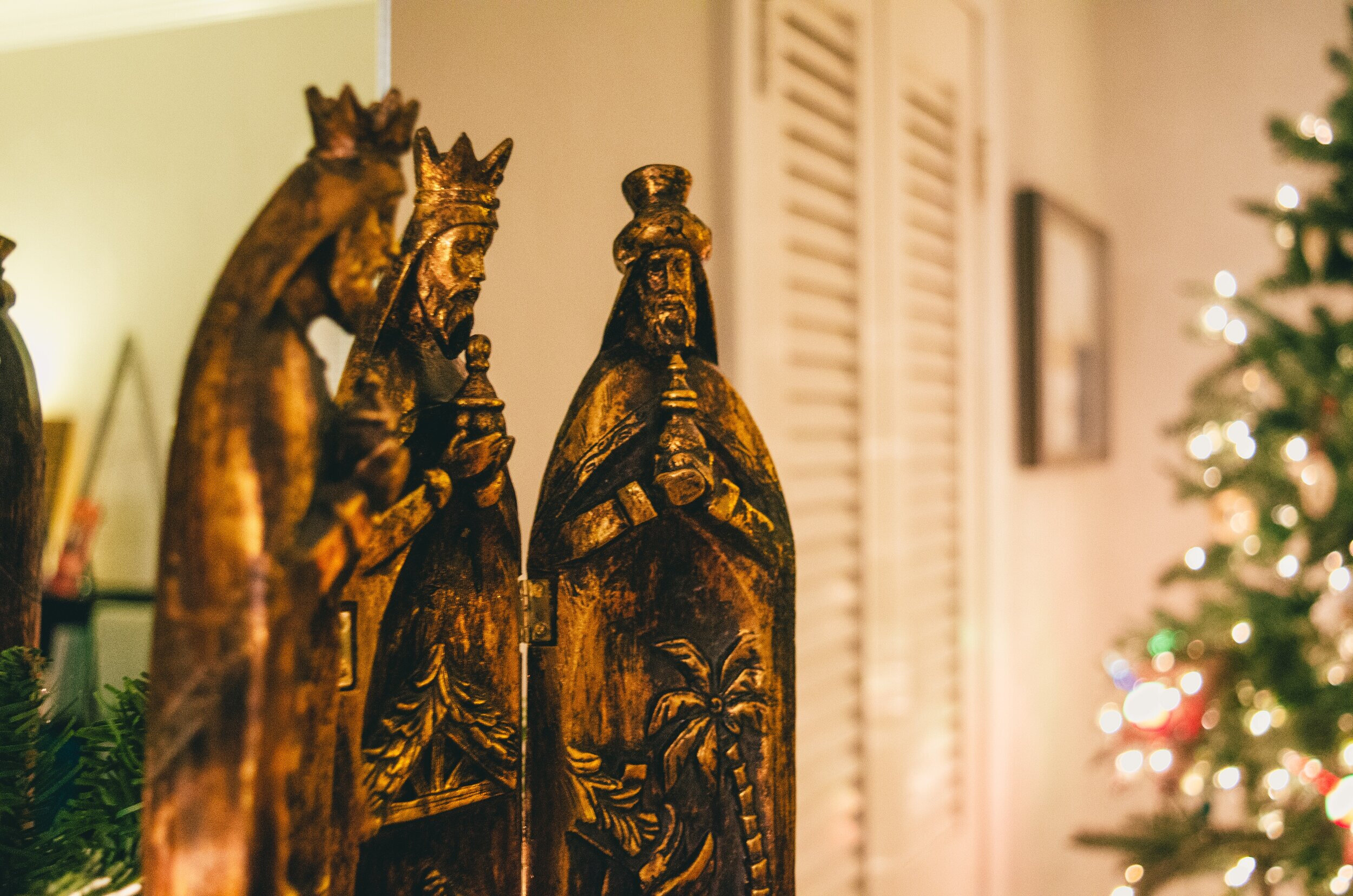
Today is the last day of the Christmas season or Christmastide. The arrival of the Magi complete the story. So many Christmas decorations and Christmas cards include images of the Magi or Wise Men that it’s easy to forget that they wandered the desert for months before arriving at the place where the star led them. So it’s appropriate that on this 12th day of Christmas we hear a story about following the light of a star and the forces of darkness that tried to smother it. Tomorrow we’ll begin the Epiphany season – shifting from rejoicing at God’s coming among us to reflecting on what it means to us and to the life of the world.

Matthew’s is the only gospel that talks about the Magi’s visit. This story gives us a level of reality that jolts us in a way that Luke does not. Luke’s gospel is full of lovely images of angels singing and shepherds with lambs kneeling before the newborn baby. Matthew’s story, though, has all the intrigue of a Hollywood blockbuster -- rampant ambition and greed, fear and lust for power. Herod, a puppet ruler of the Romans, was so insecure that he executed his mother, his wife and three sons because he feared that they were plotting to take his throne. His encounter with the Magi on their quest to find the infant king triggers Herod’s cruelty streak yet again. And so he has hundreds of baby boys murdered in a futile effort to destroy the one little boy predicted and destined to grow up and rule Israel.

The Epiphany gospel story illustrates something critically important in the development of our faith – want it means to a community united in belief as God intends us to be. This embodiment of community instead of “us” versus “them” does not come easily, however.

Christmas is a traditional time for expressions of unity. Even during world wars, combatants often stopped fighting and sang to their enemies or even walked across the battle line to share gifts with them.  At the local level, Christmas is a time when we do seem to embrace the idea of peaceful community together.

But Christmas has passed. The cards and banners proclaiming “peace on earth goodwill to all” have been put away or discarded.  And if we are honest, we understand that the spirit of peace that seems to come to easily in the lead up to Christmas is fading and will continue to fade with each passing day as we return to our regular routines. If we are honest, we will admit that no assessment of the current world and national culture is clearer than the realization that people everywhere seem willing to tolerate a deep ideological divide. We live in a time when compromise is often seen as weakness and party and tribal purity, the classic duality of “us” verses “them” thinking, is commonplace.

 “They” constitute a threat and everything about “them” is suspect.  Emotionalism, blaming and scapegoating are no longer shock us. This is a time of believing that if you do not agree with us, you must be wrong. It may go so far as a conviction that only “we” have the right answer or access to God.

This is a time when the list of “us” verses “them” seems almost endless: whites against people of color; liberals against conservatives; Westerners against Middle Easterners; Muslims against Christians; rich against poor; male against female; native against foreign. “Us” against “them.”  These aren’t easy concepts to talk about or to hear. But none of us are strangers to them, to walking on eggshells around family or friends or co-workers that we know or perhaps suspect have different views than the ones we hold. Falling into “us” versus “them” is all too easy to do. And it couldn’t take us further from being the community that God wants us to be.

The good news in today’s gospel story of honoring the Christ child is that it marks the beginning of the new understanding of peace, cooperation and unity.  It recognizes that God is the God of all people, a God of unity, a God who moves God’s people beyond the trap of “us” against “them.”  Jesus, born in a small town in a totally Jewish environment, was visited by learned scholars from another world. These foreigners came into the midst of the chosen people to remind us once more that our task is to embrace and teach the view that no one is so different that we dare treat them with less love or less respect than we would show those whom we know as brothers and sisters.

Paul’s letter to the Galatians reminds us of this: “In Christ Jesus you are all children of God through faith. There is neither Jew nor Gentile, neither slave nor free, nor is there male and female, for you are all one in Christ Jesus.”  No “other” who exists beyond God’s love. It reminds us that divisiveness like we experience so often is not consistent with the values of God. 

The reality of God is the unity of all people – Jew and gentile, Christian and Muslim, conservative and liberal, rich and poor, male and female, black and white and red and brown, married and single, gay and straight, young and old – “us” and “them.”  Through a unifying God, we are related to all people – and not just related in a common humanity but related in a much more profound way – through the Christ honored by the wise men and acknowledged as Lord of both Jew and gentile.

These "wise men from the East" were Gentiles, who saw the star -- a sign from God -- and followed it. They followed it across deserts and mountains and across natural and national barriers -- even across their own scholarly barriers of skepticism and disdain and fear -- and came at last to the place where the newborn King lay. And when they saw him, they knelt down before him. In other words, they committed themselves to follow him. And they were welcomed.

How do we know they were welcomed? Their gifts were accepted. They were given shelter. They were given safe passage back to their homes. Their story has been told through the centuries.  In fact, their gifts are prophetic symbols of the whole life of this newborn King. The gold, which represents wealth and royalty, was the sign that he would be king. The frankincense -- incense, which was burned daily in the Jerusalem temple as a holy offering to God -- was the sign that he was holy, our "Great High Priest," as the letter to the Hebrews calls him. And the myrrh, a bitter spice used to wrap the bodies of the dead, was the sign that, royal and holy though he was, he would die.

And what about us? We are the gentiles, called to be part of the covenant of love and peace, heirs of the promise of God given through the birth, death, and resurrection of Jesus Christ. We are called to transcend all the barriers to come. Not very many of us actually have to cross vast deserts on camelback. But we do have to transcend our own barriers: our skepticism and prejudices, our self-centeredness, our pre-conceived ideas, our pride -- whatever we find in the hard work of discernment separates us from the love of God. We are called out of ourselves and into Christ, to praise and worship the one who is God’s love come to earth.

And we are not alone. There are still strangers and sojourners in our world, people seeking light and truth, the love of God and the peace of Christ. The stable door is always open to all. And those of us who have arrived earlier, are called upon to welcome the stranger and traveler to the stable, to the Eucharistic table, to our hearts, and to life in Christ.

Having worshipped at the manger, the Wise Men carried the light of Christ out into the world with them, as they returned to their homes. So we, too, are called to rise from our worship at the manger and with celebrations in our hearts move steadily into the world, bearing the light of Christ -- to the places we work, the places we study, the places we play.

At the close of Christmastide in one church, a priest tells the story of one young member who was fascinated by the crèche they kept in a side chapel. More than once he found this young child in front of the figures, gazing intently and turning them over in his hands. On the day of Epiphany he got a frantic call from the child’s mother who started by stammering an apology. “What’s the matter?” the priest asked. The mother explained that her son had asked at church the previous Sunday what would happen to the crèche and figures now that Christmas was over.  His mother, trying to reassure him, said that everything would be packed away safely until Christmas Eve next year. To her surprise she found the figure of the baby Jesus on her son’s nightstand that morning. He had taken it home, he told her, because he didn’t want Jesus kept in a box. “I brought him home,” he told her. “He’ll be safe here with me.” 

We are called to go from this place keeping the baby Jesus safely with us.   

The Light of Christ!

Thanks be to God!  

Amen.